
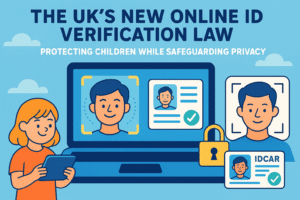
The UK’s New Online ID Verification Law: Protecting Children While Safeguarding Privacy
The UK’s New Online ID Verification Law: Protecting Children While Safeguarding Privacy
Introduction
The UK government implemented a major alteration to online content accessibility throughout the nation starting July 2025. The Online Safety Act 2023 forces all platforms to use “highly effective” age-verification technologies when minors attempt to access harmful content such as adult material, violent media, and self-harm forums. Platforms now rely on three principal verification tools: facial age estimation, photo-ID checks, and secure digital-ID wallets.
The main objective behind this law is to safeguard children from dangerous internet content. However, the new requirements have generated valid concerns regarding privacy protection, digital-access restrictions, and their effect on users and platform-management systems. At BM Technologies, we believe it is vital to assess both the benefits and the challenges of this new framework while exploring ways to enhance it for an equitable approach to digital security.
How the Law Enhances Online Safety
The Online Safety Act actively defends children from dangerous or inappropriate online encounters. By requiring stronger age-verification measures, the law seeks to prevent minors from accessing content that may harm their mental health and wellbeing.
The deployed technologies surpass traditional age-gate methods by providing more advanced privacy protections. Artificial-intelligence-based facial-age-estimation systems predict user ages without revealing personal identity. Images are discarded immediately after analysis, ensuring that no biometric data is retained. The sole purpose of the process is to determine age, not to capture identity.
Many online platforms are also adopting secure digital-identity wallets. These wallets allow users to prove their age without disclosing personal details such as name, address, or date of birth. Verification relies on strong encryption and zero-knowledge-proof protocols, which enable secure confirmation without exposing private data.
Ofcom, the UK communications regulator, is responsible for supervising the execution of these rules. It enforces high standards of data protection, security, and transparency for verification providers, all of whom must comply with the General Data Protection Regulation (GDPR) and are subject to continuous regulatory oversight.
Most platforms now offer several options for age authentication. Credit-reference checks, mobile-network accounts, passport uploads, and selfie-based verification allow users to select the method that best balances safety and convenience.
The Challenges and Concerns
Despite its worthy objectives, the new law presents significant obstacles. Users who lack official identification documents or the required technology may be excluded. Young adults, immigrants, and lower-income households could face restricted internet access because they cannot complete verification.
Although facial-age-estimation tools are designed to preserve anonymity, concerns persist about potential future uses of collected data. Critics argue that age verification could evolve into identity tracking or expose sensitive information if data breaches occur.
Virtual-private-network (VPN) usage has surged as an unintended consequence. Many UK users now bypass age checks by accessing sites from outside the country, which diminishes the law’s effectiveness and can lead them into more dangerous, unregulated parts of the internet.
Smaller websites and platforms also face financial and technical burdens. Implementing secure verification systems is costly; some services are choosing to block UK users rather than risk non-compliance penalties, further concentrating internet traffic around large, well-funded platforms.
How the System Could Be Improved
Provide Financial and Technical Support for Small Platforms
The government should offer subsidies and practical assistance to smaller websites that cannot afford commercial age-verification solutions. Without this support, many such platforms risk shutting down or limiting access for UK users.
Develop a Voluntary, Government-Backed Digital-ID System
A single, privacy-preserving digital-ID wallet—encrypted by design and available on a voluntary basis—would streamline age verification across multiple platforms while maintaining user trust.
Publish Regular Transparency Reports
Age-verification providers, together with Ofcom, should release periodic transparency reports detailing data-handling, storage, and deletion practices. Clear reporting would reassure the public that personal information is managed responsibly.
Use Anonymous or Semi-Anonymous Methods by Default
Platforms should rely on anonymous or semi-anonymous techniques, such as facial estimation or cryptographic tokens, before requesting personally identifiable information. This approach aligns with data-minimisation principles and reduces privacy risks.
Engage the Public in Ongoing Consultations
Digital-rights policies should be shaped through regular public consultations. By involving regulators, industry, and users, the UK can ensure that online-identity frameworks remain balanced and responsive to real-world needs.
Striking the Right Balance
The introduction of mandatory online age verification marks a historic milestone in UK digital regulation. Although it demonstrates a genuine commitment to child protection, the initiative must be executed thoughtfully to prevent new risks to privacy, access, and freedom of expression.
At BM Technologies, we believe safety measures can coexist with personal freedom. Through modern technology, strong oversight, and an open dialogue among government, industry, and the public, we can create a safer and more inclusive internet without compromising fundamental rights.
If your organisation is affected by these regulations or you would like guidance on integrating secure-identity tools into your digital services, contact the BM Technologies team. We deliver practical, privacy-friendly solutions that keep you compliant and competitive.